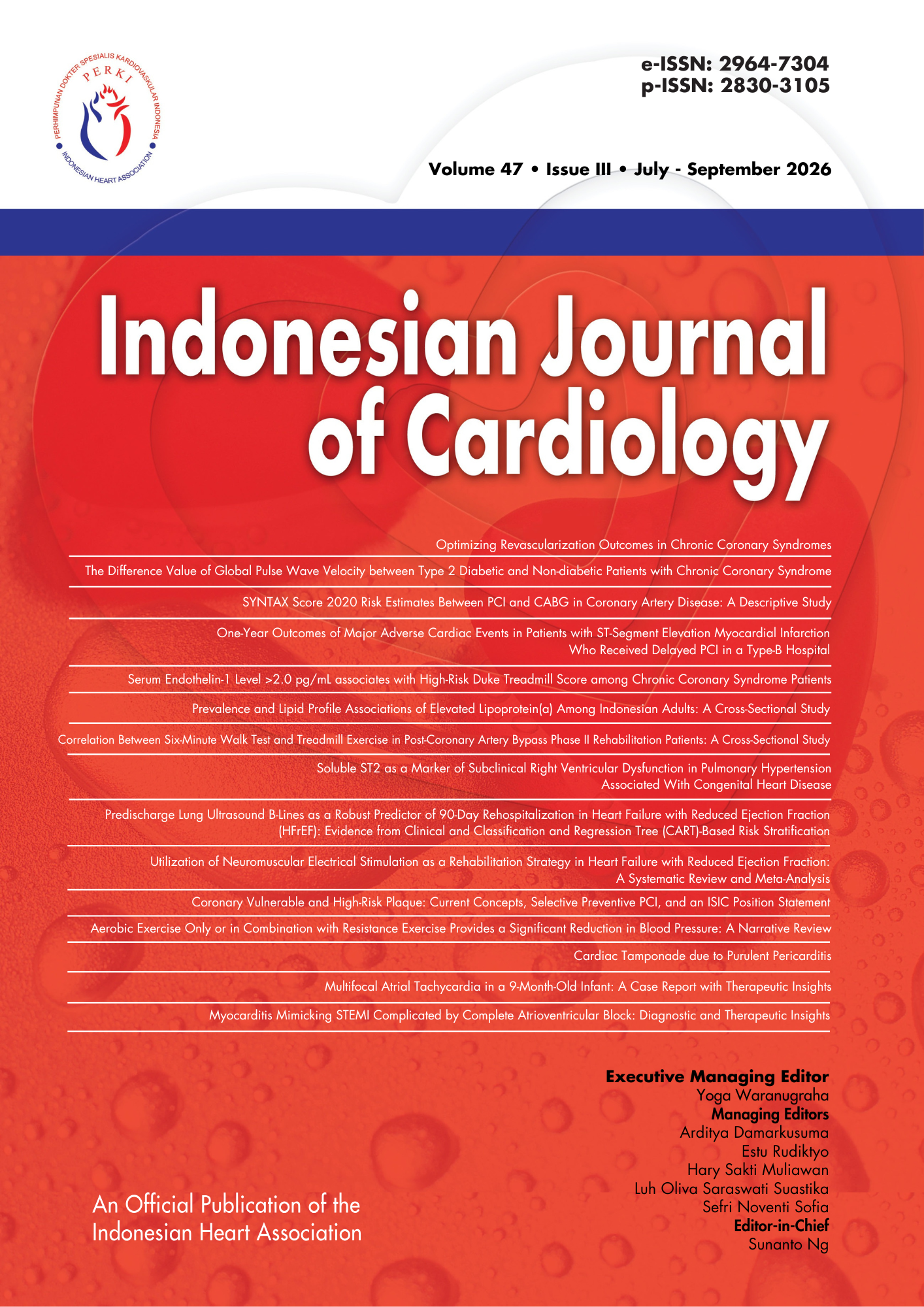
Soluble ST2 as a Marker of Subclinical Right Ventricular Dysfunction in Pulmonary Hypertension Associated With Congenital Heart Disease
DOI:
https://doi.org/10.30701/ijc.1930Keywords:
pulmonary hypertension, right ventricular dysfunction, congenital heart disease, global longitudinal strain, soluble suppression of tumorigenicity 2Abstract
Background: Congenital Heart Disease with Pulmonary Hypertension (CHD-PH) increases Right Ventricular (RV) afterload, which may lead to subclinical myocardial impairment before overt systolic dysfunction becomes apparent. Early detection is crucial to prevent progression to right heart failure. Global Longitudinal Strain (GLS) by echocardiography is sensitive for identifying subclinical RV dysfunction despite preserved conventional systolic parameters, but the role of molecular biomarkers remains unclear. Soluble Suppression of Tumorigenicity 2 (sST2) has been proposed as a potential biomarker for subclinical RV dysfunction. This study aims to compare sST2 levels in CHD-PH patients with and without subclinical RV dysfunction as assessed by RV-Global Longitudinal Strain (RV-GLS).
Methods: This cross-sectional study included adult CHD-PH patients (?18 years) at the Integrated Heart Center, RSUP M. Djamil Padang, from January to June 2025. All participants underwent right heart catheterization and had preserved RV systolic function, as assessed by conventional echocardiography (Three-Dimensional Right Ventricular Ejection Fraction [3D RVEF] ?45%). RV-GLS was assessed using Speckle-Tracking Echocardiography (STE), and serum sST2 levels were measured. Patients were categorized into subclinical RV dysfunction (GLS > –20%) and without subclinical RV dysfunction (GLS ? –20%) groups. Statistical analysis was performed to compare sST2 levels between groups.
Results: Thirty-four patients were included (82% female, mean age 37.8 ± 15.6 years), with secundum Atrial Septal Defect (ASD) as the most common etiology (71%). Median sST2 levels in patients with CHD-PH without subclinical RV dysfunction were 15.65 (6.05–40.90) ng/mL, with a GLS of –20.50 (–27.20 to –20.00)%. In patients with CHD-PH with subclinical RV dysfunction, median sST2 was 15.15 (5.25–47.60) ng/mL, with a GLS of –11.80 (–19.90 to –6.20)%. No statistically significant difference in sST2 levels was observed between groups (p = 0.89). In contrast, patients with CHD-PH with subclinical RV dysfunction exhibited significantly higher indexed Pulmonary Arterial Resistance (PAR) and pulmonary-to-Systemic Vascular Resistance ratio (PAR/SVR ratio), indicating increased pulmonary vascular load despite preserved conventional RV systolic function.
Conclusion: sST2 levels did not differ significantly between CHD-PH patients with subclinical RV dysfunction and those without. Subclinical RV dysfunction was associated with higher pulmonary vascular load, as reflected by increased indexed PAR and PAR/SVR ratio, despite preserved conventional RV systolic function. From this may conclude that subclinical RV myocardial impairment in CHD-PH is more closely related to hemodynamic afterload than to molecular stress biomarkers alone. These findings suggest that sST2 alone may have limited utility as a biomarker for detecting subclinical RV myocardial impairment in this population.
Downloads
References
2. Humbert M, Kovacs G, Hoeper MM, Badagliacca R, Berger RMF, Brida M, et al. 2022 ESC/ERS Guidelines for the diagnosis and treatment of pulmonary hypertension. European Heart Journal. Oxford University Press; 2022; 43 (1):3618–731.
3. Dinarti LK, Hartopo AB, Kusuma AD, Satwiko MG, Hadwiono MR, Pradana AD, et al. The COngenital HeARt Disease in adult and Pulmonary Hypertension (COHARD-PH) registry: A descriptive study from single-center hospital registry of adult congenital heart disease and pulmonary hypertension in Indonesia. BMC Cardiovasc Disord. 2020;20(1). 1-17
4. Raihani MS, Yanni M, Asri E, Elfi EF, Kurnia D. Gambaran Karakteristik Pasien Hipertensi Arteri Pulmonal Di Rsup Dr. M. Djamil Padang Tahun 2017-2021.2022: 1-22
5. Guignabert C, Aman J, Bonnet S, Dorfmuller P, Olschewski AJ, Pullamsetti S, et al. Pathology and pathobiology of pulmonary hypertension: current insights and future directions. In: European Respiratory Journal. European Respiratory Society; 2024: 1-14
6. Humbert M, Guignabert C, Bonnet S, Dorfmuller P, Klinger JR, Nicolls MR, et al. Pathology and pathobiology of pulmonary hypertension: State of the art and research perspectives. European Respiratory Journal. European Respiratory Society; 2019. 53 (1): 1-18
7. Sysol JR, Machado RF. Classification and pathophysiology of pulmonary hypertension. Continuing Cardiology Education. 2018;4(2):2–12.
8. Tello K, Seeger W, Naeije R, Vanderpool R, Ghofrani HA, Richter M, et al. Right heart failure in pulmonary hypertension: Diagnosis and new perspectives on vascular and direct right ventricular treatment. British Journal of Pharmacology. John Wiley and Sons Inc; 2021;178(1):90–107.
9. Haddad F, Hunt SA, Rosenthal DN, Murphy DJ. Right ventricular function in cardiovascular disease, part I: Anatomy, physiology, aging, and functional assessment of the right ventricle. Circulation. 2008; 117(1): 1436–48.
10. Vonk-Noordegraaf A, Haddad F, Chin KM, Forfia PR, Kawut SM, Lumens J, et al. Right heart adaptation to pulmonary arterial hypertension: Physiology and pathobiology. Journal of the American College of Cardiology. 2013. 1-33
11. Ro SK, Sato K, Ijuin S, Sela D, Fior G, Heinsar S, et al. Assessment and diagnosis
of right ventricular failure—retrospection and future directions. Frontiers inCardiovascular Medicine. Frontiers Media S.A.; 2023; 10(1): 3-23
12. Rajiah PS, Kalisz K, Broncano J, Goerne H, Collins JD, Francois CJ, et al.
Myocardial Strain Evaluation with Cardiovascular MRI: Physics, Principles, and
Clinical Applications. Radiographics. 2022;42(1):968–90.
13. Rudski LG, Lai WW, Afilalo J, Hua L, Handschumacher MD, Chandrasekaran K, et al. Guidelines for the Echocardiographic Assessment of the Right Heart in Adults: A Report from the American Society of Echocardiography. Endorsed by the European Association of Echocardiography, a registered branch of the 54 European Society of Cardiology, and the Canadian Society of Echocardiography. Journal of the American Society of Echocardiography. 2010; 23(1): 685–713.
14. Blessberger H, Binder T. Two dimensional speckle tracking echocardiography: Basic principles. Heart. 2010;96 (1):716–22.
15. Anderson K, Ducharme A. Markers and Correlates of Right Ventricular Function with Computed Tomography, Echocardiography, and Magnetic Resonance. In: Biomarkers in Cardiovascular Disease. Springer Netherlands; 2015. 1–38.
16. Sciatti E, Merlo A, Scangiuzzi C, Limonta R, Gori M, D’Elia E, et al. Prognostic
Value of sST2 in Heart Failure. Journal of Clinical Medicine. Multidisciplinary Digital Publishing Institute (MDPI); 2023; 12(1): 221-225
17. Dudek M, Ka?u?na-Oleksy M, Migaj J, Sawczak F, Krysztofiak H, Lesiak M, et al. sST2 and Heart Failure—Clinical Utility and Prognosis. J Clin Med. 2023;12(1) :12-21
18. Ye H, Wu Q, Zhang N, Shi J, Zhang H, Wang Q, et al. The prognostic value of
sST2 in connective tissue disease patients with pulmonary hypertension.
Rheumatology (United Kingdom). 2022;61(2):3989–96.
19. Zhang T, Xu C, Zhao R, Cao Z. Diagnostic Value of sST2 in Cardiovascular Diseases: A Systematic Review and Meta-Analysis. Frontiers in Cardiovascular Medicine. Frontiers Media S.A. 2021; 8 (1): 1-11
20. Aimo A, Januzzi JL, Bayes-Genis A, Vergaro G, Sciarrone P, Passino C, et al. Clinical and Prognostic Significance of sST2 in Heart Failure: JACC Review Topic of the Week. Journal of the American College of Cardiology. Elsevier USA; 2019. 74(2): 2193–203.
21. Rafikova O, Al Ghouleh I, Rafikov R. Focus on Early Events: Pathogenesis of Pulmonary Arterial Hypertension Development. Antioxidants and Redox Signaling. Mary Ann Liebert Inc. 2019;31(1) : 933–53.
22. Harikrishnan S, Mani A, G S, M A, Menon J, G R, et al. Pulmonary Hypertension Registry of Kerala, India (PRO-KERALA): One-year outcomes. Indian Heart J. 2022;74:34–9.
23. Kucukoglu SM, Kaymaz C, Alehan D, Kula S, Akcevin A, Celiker A, et al. Pulmonary arterial hypertension associated with congenital heart disease: lessons learnt from the large Turkish Nationwide Registry (THALES). Pulm Circ. 2021;11. 1-22
24. Saputra F, Hartopo AB, Hariawan H, Anggrahini DW, Kris Dinarti L. Association between serum soluble ST2 level and right ventricle systolic function on pulmonary hypertension due to atrial septal defect. Journal of thee Medical Sciences (Berkala Ilmu Kedokteran). 2020;52. 1-16.
25. Farber HW, Chakinala MM, Cho M, Frantz RP, Frick A, Lancaster L, et al. Characteristics of patients with pulmonary arterial hypertension from an innovative, comprehensive real-world patient data repository. Pulm Circ. 2023;13(1). 1-12
26. Ciccone MM, Cortese F, Gesualdo M, Riccardi R, Di Nunzio D, Moncelli M, et al. A novel cardiac bio-marker: ST2: a review. Molecules. 2013; 18 (1) : 15314–28.
27. Yan L, Shi W, Liu Z, Zhao Z, Luo Q, Zhao Q, et al. The benefit of exercise-based rehabilitation programs in patients with pulmonary hypertension: a systematic review and meta-analysis of randomized controlled trials. Pulm Circ. 2021;11(2). 1-27
28. Toma M, Savonitto G, Lombardi CM, Airo E, Driussi M, Gentile P, et al. Frequency, characteristics and risk assessment of pulmonary arterial hypertension with a left heart disease phenotype. Clinical Research in Cardiology. 2025;114:215–26.
29. Kovacs G, Bartolome S, Denton CP, Gatzoulis MA, Gu S, Khanna D, et al. Definition, classification and diagnosis of pulmonary hypertension. European Respiratory Journal. European Respiratory Society; 2024. 1-14.
30. Hameed A, Condliffe R, Swift AJ, Alabed S, Kiely DG, Charalampopoulos A. Assessment of Right Ventricular Function—a State of the Art. Current Heart Failure Reports. Springer; 2023. 20 (1): 194–207.
31. Maron BA, Kovacs G, Vaidya A, Bhatt DL, Nishimura RA, Mak S, et al. Cardiopulmonary Hemodynamics in Pulmonary Hypertension and Heart Failure: JACC Review Topic of the Week. Journal of the American College of Cardiology. Elsevier Inc.; 2020; 76(1): 2671–81.
32. Geenen LW, Baggen VJM, Kauling RM, Koudstaal T, Boomars KA, Boersma E, et al. The prognostic value of soluble ST2 in adults with pulmonary hypertension. J Clin Med. 2019;8(1): 1-11.
33. Pratama RS, Hartopo AB, Anggrahini DW, Dewanto VC, Dinarti LK. Serum soluble suppression of tumorigenicity-2 level associates with severity of pulmonary hypertension associated with uncorrected atrial septal defect. Pulm Circ. 2020;10(1): 1-11.
34. Banaszkiewicz M, Pietrasik A, Darocha S, Pi?ka M, Florczyk M, Dobosiewicz A, et al. Soluble ST2 protein as a new biomarker in patients with precapillary pulmonary hypertension. Archives of Medical Science. 2024;20(2):1442–51.
Downloads
Published
How to Cite
Issue
Section
License
Authors who publish with this journal agree to the following terms:
- Authors retain copyright and grant the journal right of first publication with the work simultaneously licensed under a Creative Commons Attribution License that allows others to share the work with an acknowledgement of the work's authorship and initial publication in this journal.
- Authors are able to enter into separate, additional contractual arrangements for the non-exclusive distribution of the journal's published version of the work (e.g., post it to an institutional repository or publish it in a book), with an acknowledgement of its initial publication in this journal.
- Authors are permitted and encouraged to post their work online (e.g., in institutional repositories or on their website) prior to and during the submission process, as it can lead to productive exchanges, as well as earlier and greater citation of published work (See The Effect of Open Access).