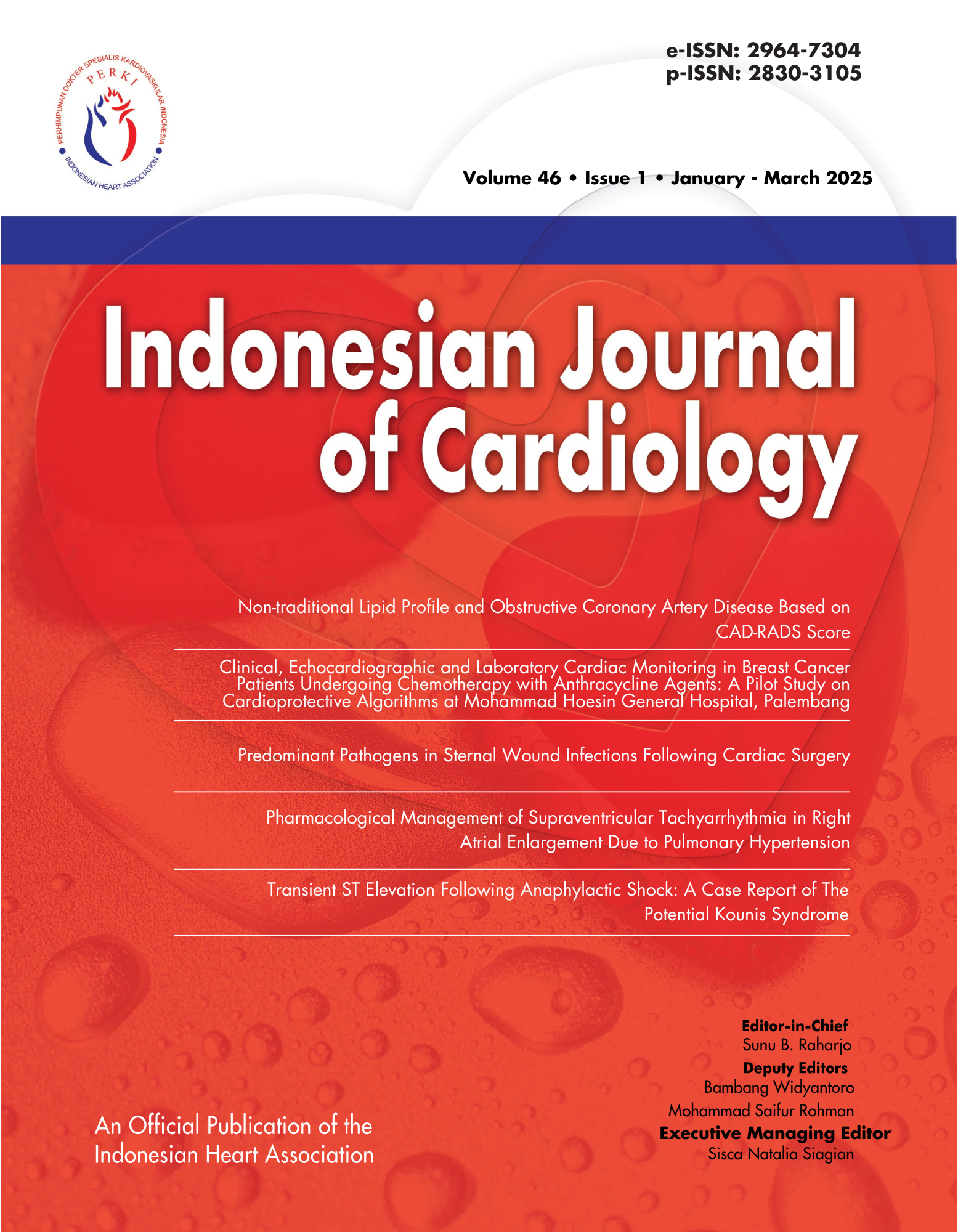
Pharmacological Management of Supraventricular Tachyarrhythmia in Right Atrial Enlargement Due to Pulmonary Hypertension: Case Series
Abstract
Background
Right atrial (RA) enlargement is a common finding in patients with pulmonary hypertension (PH). Supraventricular arrhythmia (SVA) is common in PH patients with RA enlargement. Treatment of SVA should be aggressive since it can cause hemodynamic worsening consequences because RA function plays an important role in right heart function.
Case Illustration
Three cases of SVA in underlying right heart enlargement with preserved ventricular function that successfully managed by pharmacological cardioversion according to the guidelines. The first case describes atrial flutter with right bundle branch block (RBBB) morphology which successfully converted to sinus rhythm by amiodarone (class III antiarrhythmic drug) administration, meanwhile the second and third cases demonstrate paroxysmal SVA that converted to sinus rhythm by diltiazem (class IV antiarrhythmic drug) administration.
Conclusion
Supraventricular arrhythmia is a frequent arrhythmia that occurs in pulmonary hypertensive and right heart dilation patients. The tachyarrhythmia in this patient population tolerated poorly and led to hemodynamic perturbation. Pharmacological cardioversion is one of the effective approaches to alleviate patient symptoms with significant clinical improvement.
Downloads
References
2. Medi C, Kalman JM, Ling LH, et al. Atrial electrical and structural remodeling associated with longstanding pulmonary hypertension and right ventricular hypertrophy in humans. J Cardiovasc Electrophysiol. 2012;23(6). doi:10.1111/j.1540-8167.2011.02255.x
3. Mullin CJ, Ventetuolo CE. Critical Care Management of the Patient with Pulmonary Hypertension. Clin Chest Med. 2021;42(1). doi:10.1016/j.ccm.2020.11.009
4. Peng G, Zei PC. Diagnosis and Management of Paroxysmal Supraventricular Tachycardia. JAMA. 2024;331(7). doi:10.1001/jama.2024.0076
5. Olsson KM, Nickel NP, Tongers J, Hoeper MM. Atrial flutter and fibrillation in patients with pulmonary hypertension. Int J Cardiol. 2013;167(5). doi:10.1016/j.ijcard.2012.06.024
6. Brugada J, Katritsis DG, Arbelo E, et al. 2019 ESC Guidelines for the management of patients with supraventricular tachycardiaThe Task Force for the management of patients with supraventricular tachycardia of the European Society of Cardiology (ESC). Eur Heart J. Published online 2019. doi:10.1093/eurheartj/ehz467
7. Raharjo SB, Yuniadi Y, Muzakkir M, Yansen I, Munawar DA, Hermanto DY. Pedoman Tatalaksana Takiaritmia Supraventrikular (TaSuV). Indones J Cardiol. Published online 2017. doi:10.30701/ijc.v38i2.734
8. Condliffe R, Kiely DG. Critical care management of pulmonary hypertension. BJA Educ. 2017;17(7). doi:10.1093/bjaed/mkw074
9. Grignola JC, Domingo E. Acute Right Ventricular Dysfunction in Intensive Care Unit. Biomed Res Int. 2017;2017. doi:10.1155/2017/8217105
10. Barnett CF, O’brien C, De Marco T. Critical care management of the patient with pulmonary hypertension. Eur Hear J Acute Cardiovasc Care. 2022;11(1). doi:10.1093/ehjacc/zuab113
11. Małaczyńska-Rajpold K, Komosa A, Błaszyk K, et al. The Management of Supraventricular Tachyarrhythmias in Patients with Pulmonary Arterial Hypertension. Hear Lung Circ. 2016;25(5). doi:10.1016/j.hlc.2015.10.008
PDF downloads: 609
Copyright (c) 2025 Indonesian Journal of Cardiology

This work is licensed under a Creative Commons Attribution 4.0 International License.
Authors who publish with this journal agree to the following terms:
- Authors retain copyright and grant the journal right of first publication with the work simultaneously licensed under a Creative Commons Attribution License that allows others to share the work with an acknowledgement of the work's authorship and initial publication in this journal.
- Authors are able to enter into separate, additional contractual arrangements for the non-exclusive distribution of the journal's published version of the work (e.g., post it to an institutional repository or publish it in a book), with an acknowledgement of its initial publication in this journal.
- Authors are permitted and encouraged to post their work online (e.g., in institutional repositories or on their website) prior to and during the submission process, as it can lead to productive exchanges, as well as earlier and greater citation of published work (See The Effect of Open Access).