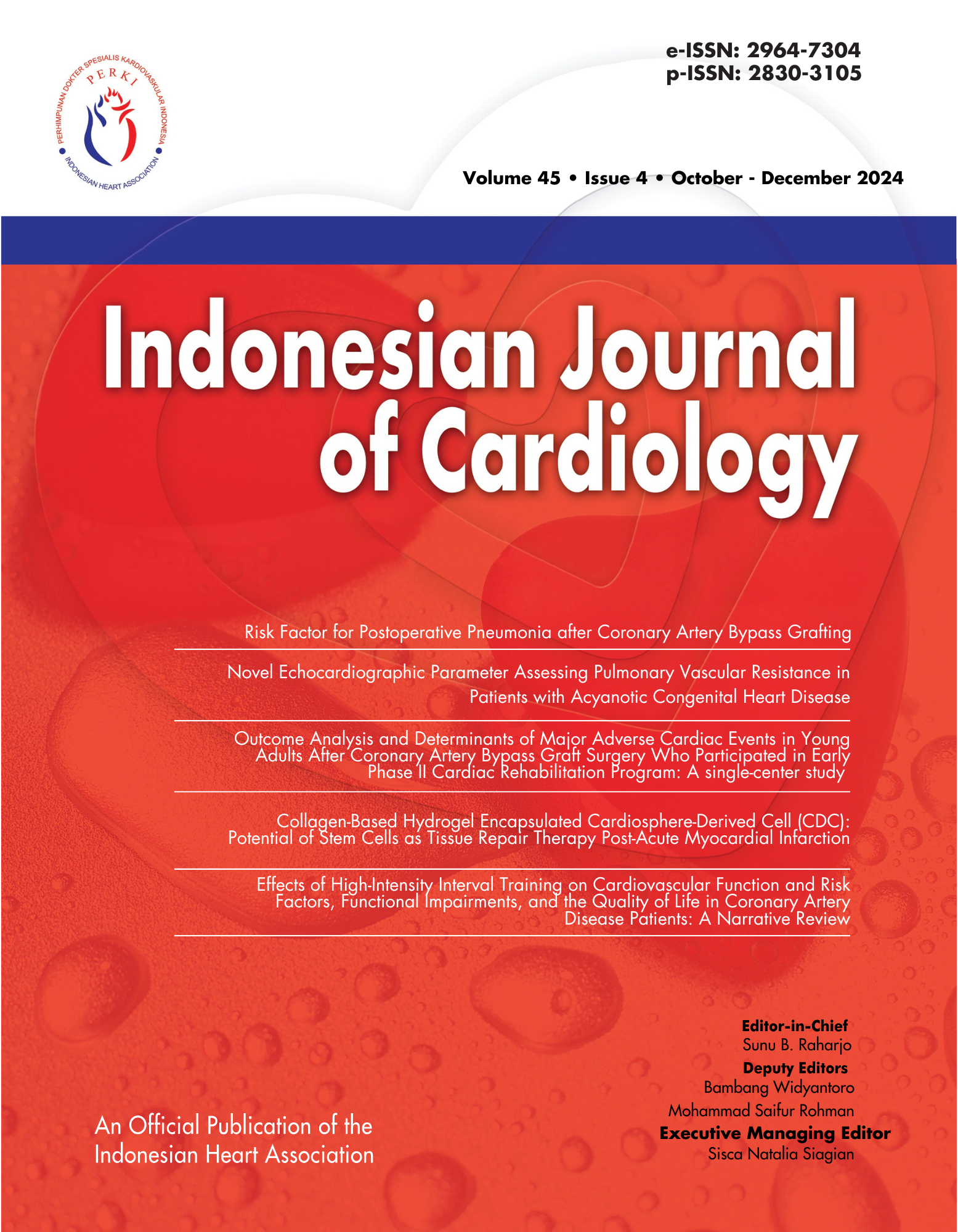
Effects of High-Intensity Interval Training on Cardiovascular Function and Risk Factors, Functional Impairments, and the Quality of Life in Coronary Artery Disease Patients: A Narrative Review
Abstract
Background: Coronary artery disease (CAD) causes damage to the cardiovascular system that leads to functional and quality of life (QoL) deterrence. Cardiac rehabilitation (CR) aims to improve cardiorespiratory fitness (CRF) to prevent disease progression and its risk factors. Aerobic exercise (AE) causes different physiological effects depending on the applied intensity. High-intensity interval training (HIIT) is being developed because of better effectivity than moderate-intensity continuous training (MICT). Even so, HIIT has not been prescribed generally. This review aimed to describe the effects of HIIT on cardiovascular function and risk factors, functional impairments, and the QoL.
Methods: Articles were searched using PubMed and CINAHL databases with the keywords “high-intensity interval training”, “cardiac rehabilitation”, “exercise-based cardiac rehabilitation”, and “coronary artery disease”.
Results: Twenty-two articles were found and used to explain sub-topics.
Discussion: HIIT improves ventricular function, LVEF, heart contractility, and endothelial function which further improve systolic and diastolic blood pressure. Improvement in cardiovascular risk factors was better in HIIT compared to AE in lower intensities. Studies recommend HIIT for CAD patients due to significant cardiovascular adaptation in this exercise. Compared to MICT, most studies found that HIIT is better at improving CRF. HIIT also positively affects cognitive and affective functions. Research on the impact of HIIT on functional activity and QoL is still limited. However, one study found no differences in physical activity level and QoL in groups given HIIT or MICT.
Conclusion: In CAD patients, HIIT is considered an alternative exercise that is more time-efficient than continuous exercise.
Downloads
References
2. Winnige P, Vysoky R, Dosbaba F, Batalik L. Cardiac rehabilitation and its essential role in the secondary prevention of cardiovascular diseases. World J Clin Cases. 2021;9(8):1761-84.
3. Nazir A, Anggraini G. Implementation of home-based cardiac rehabilitation program in patients with coronary artery disease: A literature review. IndoJPMR. 2023;12(02):164-77.
4. Taylor RS, Dalal HM, McDonagh ST. The role of cardiac rehabilitation in improving cardiovascular outcomes. Nat Rev Cardiol. 2022;19(3):180-94.
5. Mitchell BL, Lock MJ, Davison K, Parfitt G, Buckley JP, Eston RG. What is the effect of aerobic exercise intensity on cardiorespiratory fitness in those undergoing cardiac rehabilitation? A systematic review with meta-analysis. Br J Sports Med. 2019;53(21):1341-51.
6. Taylor JL, Bonikowske AR, Olson TP. Optimizing outcomes in cardiac rehabilitation: the importance of exercise intensity. Front Cardiovasc Med. 2021;8:734278.
7. Huang G, Wang R, Chen P, Huang SC, Donnelly JE, Mehlferber JP. Dose–response relationship of cardiorespiratory fitness adaptation to controlled endurance training in sedentary older adults. Eur J Prev Cardiol. 2016;23(5):518-29.
8. Ross R, Blair SN, Arena R, Church TS, Després J-P, Franklin BA, et al. Importance of assessing cardiorespiratory fitness in clinical practice: a case for fitness as a clinical vital sign: a scientific statement from the American Heart Association. Circulation. 2016;134(24):e653-e99.
9. Sérvio TC, Britto RR, de Melo Ghisi GL, da Silva LP, Silva LDN, Lima MMO, et al. Barriers to cardiac rehabilitation delivery in a low-resource setting from the perspective of healthcare administrators, rehabilitation providers, and cardiac patients. BMC Health Serv Res. 2019;19(1):615.
10. McGregor G, Nichols S, Hamborg T, Bryning L, Tudor-Edwards R, Markland D, et al. High-intensity interval training versus moderate-intensity steady-state training in UK cardiac rehabilitation programmes (HIIT or MISS UK): study protocol for a multicentre randomised controlled trial and economic evaluation. BMJ Open. 2016;6(11):e012843.
11. Guiraud T, Nigam A, Gremeaux V, Meyer P, Juneau M, Bosquet L. High-intensity interval training in cardiac rehabilitation. Sports Med. 2012;42(7):587-605.
12. Wewege MA, Ahn D, Yu J, Liou K, Keech A. High‐intensity interval training for patients with cardiovascular disease—is it safe? A systematic review. J Am Heart Assoc. 2018;7(21):e009305.
13. Way KL, Vidal-Almela S, Keast M-L, Hans H, Pipe AL, Reed JL. The feasibility of implementing high-intensity interval training in cardiac rehabilitation settings: a retrospective analysis. BMC Sports Sci Med Rehabil. 2020;12:38.
14. Brubaker PH, Ross JH, Joo KC. Contemporary approaches to prescribing exercise in coronary artery disease patients. Am J Lifestyle Med. 2018;12(2):130-9.
15. Ribeiro PA, Boidin M, Juneau M, Nigam A, Gayda M. High-intensity interval training in patients with coronary heart disease: prescription models and perspectives. Ann Phys Rehabil Med. 2017;60(1):50-7.
16. Uhlemann M, Adams V, Lenk K, Linke A, Erbs S, Adam J, et al. Impact of different exercise training modalities on the coronary collateral circulation and plaque composition in patients with significant coronary artery disease (EXCITE trial): study protocol for a randomized controlled trial. Trials. 2012;13:167.
17. Madssen E, Arbo I, Granøien I, Walderhaug L, Moholdt T. Peak oxygen uptake after cardiac rehabilitation: a randomized controlled trial of a 12-month maintenance program versus usual care. PLoS One. 2014;9(9):e107924.
18. Rognmo Ø, Moholdt T, Bakken H, Hole T, Mølstad P, Myhr NE, et al. Cardiovascular risk of high-versus moderate-intensity aerobic exercise in coronary heart disease patients. Circulation. 2012;126(12):1436-40.
19. Wu L-H, Chang S-C, Fu T-C, Huang C-H, Wang J-S. High-intensity interval training improves mitochondrial function and suppresses thrombin generation in platelets undergoing hypoxic stress. Sci Rep. 2017;7(1):4191.
20. Hannan AL, Hing W, Simas V, Climstein M, Coombes JS, Jayasinghe R, et al. High-intensity interval training versus moderate-intensity continuous training within cardiac rehabilitation: a systematic review and meta-analysis. Open Access J Sports Med. 2018;9:1-17.
21. Kolmos M, Krawcyk RS, Kruuse C. Effect of high-intensity training on endothelial function in patients with cardiovascular and cerebrovascular disease: a systematic review. SAGE Open Med. 2016;4:2050312116682253.
22. Maturana FM, Schellhorn P, Erz G, Burgstahler C, Widmann M, Munz B, et al. Individual cardiovascular responsiveness to work-matched exercise within the moderate-and severe-intensity domains. Eur J Appl Physiol. 2021;121(7):2039-59.
23. Zhang X, Xu D, Sun G, Jiang Z, Tian J, Shan Q. Effects of high‐intensity interval training in patients with coronary artery disease after percutaneous coronary intervention: A systematic review and meta‐analysis. Nurs Open. 2021;8(3):1424-35.
24. Bacon AP, Carter RE, Ogle EA, Joyner MJ. VO2max trainability and high intensity interval training in humans: a meta-analysis. PLoS One. 2013;8(9):e73182.
25. Villelabeitia-Jaureguizar K, Vicente-Campos D, Senen AB, Jiménez VH, Bautista LR, Garrido-Lestache MEB, et al. Mechanical efficiency of high versus moderate intensity aerobic exercise in coronary heart disease patients: A randomized clinical trial. Cardiol J. 2019;26(2):130-7.
26. Xie B, Yan X, Cai X, Li J. Effects of high-intensity interval training on aerobic capacity in cardiac patients: a systematic review with meta-analysis. Biomed Res Int. 2017;2017:5420840.
27. Abdelhalem A, Shabana A, Onsy A, Gaafar A. High intensity interval training exercise as a novel protocol for cardiac rehabilitation program in ischemic Egyptian patients with mild left ventricular dysfunction. Egypt Heart J. 2018;70(4):287-94.
28. Blackwell JE, Doleman B, Herrod PJ, Ricketts S, Phillips BE, Lund JN, et al. Short-term (< 8 wk) high-intensity interval training in diseased cohorts. Med Sci Sports Exerc. 2018;50(9):1740-9.
29. Cardozo GG, Oliveira RB, Farinatti PT. Effects of high intensity interval versus moderate continuous training on markers of ventilatory and cardiac efficiency in coronary heart disease patients. ScientificWorldJournal. 2015;2015:192479.
30. Prado D, Rocco E, Silva A, Rocco D, Pacheco M, Silva P, et al. Effects of continuous vs interval exercise training on oxygen uptake efficiency slope in patients with coronary artery disease. Braz J Med Biol Res. 2016;49(2):e4890.
31. Ai J-Y, Chen F-T, Hsieh S-S, Kao S-C, Chen A-G, Hung T-M, et al. The effect of acute high-intensity interval training on executive function: A systematic review. Int J Environ Res Public Health. 2021;18(7):3593.
32. Oliveira BRR, Santos TM, Kilpatrick M, Pires FO, Deslandes AC. Affective and enjoyment responses in high intensity interval training and continuous training: A systematic review and meta-analysis. PLoS One. 2018;13(6):e0197124.
33. Jung ME, Bourne JE, Little JP. Where does HIT fit? An examination of the affective response to high-intensity intervals in comparison to continuous moderate-and continuous vigorous-intensity exercise in the exercise intensity-affect continuum. PLoS One. 2014;9(12):e114541.
PDF downloads: 745
Copyright (c) 2025 Indonesian Journal of Cardiology

This work is licensed under a Creative Commons Attribution 4.0 International License.
Authors who publish with this journal agree to the following terms:
- Authors retain copyright and grant the journal right of first publication with the work simultaneously licensed under a Creative Commons Attribution License that allows others to share the work with an acknowledgement of the work's authorship and initial publication in this journal.
- Authors are able to enter into separate, additional contractual arrangements for the non-exclusive distribution of the journal's published version of the work (e.g., post it to an institutional repository or publish it in a book), with an acknowledgement of its initial publication in this journal.
- Authors are permitted and encouraged to post their work online (e.g., in institutional repositories or on their website) prior to and during the submission process, as it can lead to productive exchanges, as well as earlier and greater citation of published work (See The Effect of Open Access).