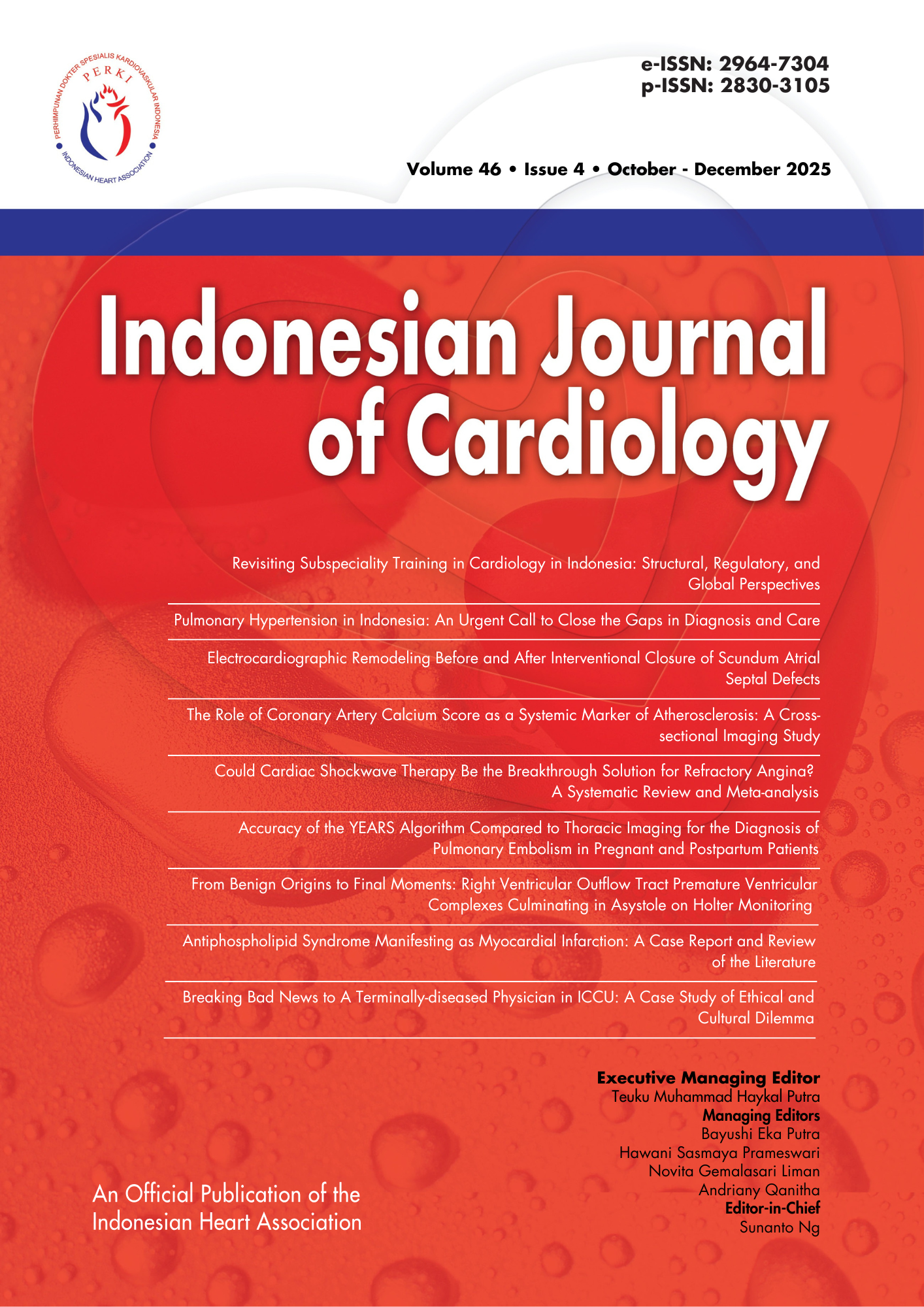
Could Cardiac Shockwave Therapy be the Breakthrough Solution for Refractory Angina? A Systematic Review and Meta-Analysis
DOI:
https://doi.org/10.30701/ijc.1851Keywords:
cardiac shockwave therapy, refractory angina, Non-invasive Cardiac Therapy, Chronic Angina Treatment, Innovative Angina TherapiesAbstract
Background: Refractory angina (RA) is a chronic condition unresponsive to standard treatments like PCI or CABG, leaving limited options for many patients. Cardiac shockwave therapy (CSWT) is a novel, noninvasive approach that enhances myocardial perfusion through microvascular regeneration. This systematic review and meta-analysis evaluate the effectiveness of CSWT in managing RA. Methods: A comprehensive literature search was conducted using electronic databases (Cochrane, PubMed, and ScienceDirect), including comparative studies with controls that evaluated CSWT in RA patients between 2010 and 2024. Studies not in English, with irrelevant outcomes, or lacking full-text access, were excluded. Data were extracted and analyzed using a random-effects model to address heterogeneity. Results: Seven studies, including 3 randomized controlled trials (RCTs) and 4 observational studies, with a total of 417 patients were analyzed. CSWT demonstrated significant improvements in multiple clinical outcomes. CSWT reduces angina severity in CSWT reduces angina severity in CCS grade (MD -0.76, 95% CI -0.97, -0.55, P < 0.00001) and in NYHA class (MD -0.62, 95% CI -0.95, -0.30, P = 0.0002), increased the 6- Minute Walk Test (6MWT) distance by 57.63 meters (MD 57.63, 95% CI 16.71, 98.54, P = 0.006), increased SAQ scores by 10.96 points (MD 10.96, 95% CI 1.66, 20.26, P = 0.02), improved LVEF by 4.43% (MD 4.43, 95% CI: 2.66 to 6.21, P< 0.01), and decreased nitroglycerin usage by 1.62 intake per week (MD -1.62, 95% CI -2.61, -0.62, P = 0.001). However, there was no significant difference in LVEDD between the two groups. Conclusion: CSWT appears to be a promising therapeutic option for patients with RA, demonstrating improvement in CCS angina class, NYHA class, 6-min walk test distances, SAQ score, LVEF, and reduces nitroglycerin usage.
Keyword: Cardiac Shockwave Therapy, Refractory Angina, Non-invasive Cardiac Therapy, Chronic Angina Treatment, Innovative Angina Therapies
Downloads
References
[2] F. J. Neumann et al., “2019 ESC Guidelines for the diagnosis and management of chronic coronary syndromes,” Jan. 14, 2020, Oxford University Press. doi: 10.1093/eurheartj/ehz425.
[3] J. Vainer et al., “Cardiac shockwave therapy in patients with chronic refractory angina pectoris,” Netherlands Heart Journal, vol. 24, no. 5, pp. 343–349, May 2016, doi: 10.1007/s12471-016-0821-y.
[4] A. Davies, K. Fox, A. R. Galassi, S. Banai, S. Ylä-Herttuala, and T. F. Lüscher, “Management of refractory angina: An update,” Jan. 14, 2021, Oxford University Press. doi: 10.1093/eurheartj/ehaa820.
[5] H. T. Yang, X. Xie, X. G. Hou, W. J. Xiu, and T. T. Wu, “Cardiac shock wave therapy for coronary heart disease: An updated meta-analysis,” Braz J Cardiovasc Surg, vol. 35, no. 5, pp. 741–756, 2020, doi: 10.21470/1678-9741-2019-0276.
[6] A. Cassar et al., “Safety and efficacy of extracorporeal shock wave myocardial revascularization therapy for refractory angina pectoris,” Mayo Clin Proc, vol. 89, no. 3, pp. 346–354, 2014, doi: 10.1016/j.mayocp.2013.11.017.
[7] M. Slavich et al., “Extracorporeal myocardial shockwave therapy; a precious blast for refractory angina patients,” Cardiovascular Revascularization Medicine, vol. 19, no. 3, pp. 263–267, Apr. 2017, doi: 10.1016/j.carrev.2017.09.018.
[8] J. A. C. Sterne et al., “RoB 2: A revised tool for assessing risk of bias in randomised trials,” The BMJ, vol. 366, 2019, doi: 10.1136/bmj.l4898.
[9] L. Weijing et al., “Cardiac Shock Wave Therapy Ameliorates Myocardial Ischemia in Patients With Chronic Refractory Angina Pectoris: A Randomized Trial,” Front Cardiovasc Med, vol. 8, 2021, doi: 10.3389/fcvm.2021.664433.
[10] P. Yang et al., “Randomized and double-blind controlled clinical trial of extracorporeal cardiac shock wave therapy for coronary heart disease,” Heart Vessels, vol. 28, no. 3, pp. 284–291, May 2012, doi: 10.1007/s00380-012-0244-7.
[11] G. Alunni et al., “The beneficial effect of extracorporeal shockwave myocardial revascularization: Two years of follow-up,” Cardiovascular Revascularization Medicine, vol. 18, no. 8, pp. 572–576, Dec. 2015, doi: 10.1016/j.carrev.2017.05.006.
[12] S. Nirala, Y. Wang, Y. Z. Peng, P. Yang, and T. Guo, “Cardiac shock wave therapy shows better outcomes in the coronary artery disease patients in a long term,” Eur Rev Med Pharmacol Sci, vol. 2, 2016.
[13] W. H. Kazmi, S. Z. Rasheed, S. Ahmed, M. Saadat, S. Altaf, and A. Samad, “Noninvasive therapy for the management of patients with advanced coronary artery disease,” Coron Artery Dis, vol. 23, no. 8, pp. 549–554, Dec. 2012, doi: 10.1097/MCA.0b013e328358a606.
[14] E. Shkolnik et al., “A randomized, triple-blind trial of cardiac shock-wave therapy on exercise tolerance and symptoms in patients with stable angina pectoris,” Coron Artery Dis, vol. 29, no. 7, pp. 579–586, Nov. 2018, doi: 10.1097/MCA.0000000000000648.
[15] G. Ditac, F. Bessière, and C. Lafon, “Therapeutic Ultrasound Applications in Cardiovascular Diseases: A Review,” IRBM, vol. 44, no. 2, Apr. 2023, doi: 10.1016/j.irbm.2022.07.001.
[16] G. Gallone et al., “Refractory Angina: From Pathophysiology to New Therapeutic Nonpharmacological Technologies,” Jan. 13, 2020, Elsevier Inc. doi: 10.1016/j.jcin.2019.08.055.
[17] C. Gollmann-Tepeköylü et al., “miR-19a-3p containing exosomes improve function of ischemic myocardium upon shock wave therapy”, doi: 10.1093/cvr/cvz209/5549496.
[18] C. Tepeköylü et al., “Shockwaves prevent from heart failure after acute myocardial ischaemia via RNA/protein complexes,” J Cell Mol Med, vol. 21, no. 4, pp. 791–801, Apr. 2017, doi: 10.1111/jcmm.13021.
[19] J. Holfeld, D. Lobenwein, C. Tepeköylü, and M. Grimm, “Shockwave therapy of the heart,” Dec. 01, 2015, Elsevier Ltd. doi: 10.1016/j.ijsu.2015.09.070.
[20] W. Yang et al., “Cardiac shock wave therapy promotes arteriogenesis of coronary micrangium, and ILK is involved in the biomechanical effects by proteomic analysis,” Sci Rep, vol. 8, no. 1, Dec. 2018, doi: 10.1038/s41598-018-19393-z.
[21] X. Wu, M. Gu, Y. Ma, P. Song, and C. Fang, “Observation of the effectiveness of clinical indicators of cardiac shock wave therapy in patients with ischemic heart disease: A systematic review and meta-analysis,” Jan. 24, 2023, Frontiers Media S.A. doi: 10.3389/fcvm.2023.1088811.
[22] Y. Kikuchi et al., “Double-blind and placebo-controlled study of the effectiveness and safety of extracorporeal cardiac shock wave therapy for severe angina pectoris,” Circulation Journal, vol. 74, no. 3, pp. 589–591, Mar. 2010, doi: 10.1253/circj.CJ-09-1028.
[23] J. Dumfarth et al., “Prophylactic Low-Energy Shock Wave Therapy Improves Wound Healing After Vein Harvesting for Coronary Artery Bypass Graft Surgery: A Prospective, Randomized Trial,” Annals of Thoracic Surgery, vol. 86, no. 6, pp. 1909–1913, Dec. 2008, doi: 10.1016/j.athoracsur.2008.07.117.
[24] M. Graber et al., “Cardiac Shockwave Therapy – A Novel Therapy for Ischemic Cardiomyopathy?,” May 12, 2022, Frontiers Media S.A. doi: 10.3389/fcvm.2022.875965.
[25] H. Shimokawa, “Therapeutic potentials of sound waves in cardiovascular medicine: further important evidence,” Aug. 01, 2024, Oxford University Press. doi: 10.1093/eurheartj/ehae253.
[26] G. Burneikaite et al., “Cardiac shock-wave therapy in the treatment of coronary artery disease: Systematic review and meta-analysis,” Apr. 12, 2017, BioMed Central Ltd. doi: 10.1186/s12947-017-0102-y.
[27] G. Alunni et al., “The beneficial effect of extracorporeal shockwave myocardial revascularization in patients with refractory angina,” Cardiovascular Revascularization Medicine, vol. 16, no. 1, pp. 6–11, Jan. 2015, doi: 10.1016/j.carrev.2014.10.011.
Downloads
Published
How to Cite
Issue
Section
License
Authors who publish with this journal agree to the following terms:
- Authors retain copyright and grant the journal right of first publication with the work simultaneously licensed under a Creative Commons Attribution License that allows others to share the work with an acknowledgement of the work's authorship and initial publication in this journal.
- Authors are able to enter into separate, additional contractual arrangements for the non-exclusive distribution of the journal's published version of the work (e.g., post it to an institutional repository or publish it in a book), with an acknowledgement of its initial publication in this journal.
- Authors are permitted and encouraged to post their work online (e.g., in institutional repositories or on their website) prior to and during the submission process, as it can lead to productive exchanges, as well as earlier and greater citation of published work (See The Effect of Open Access).