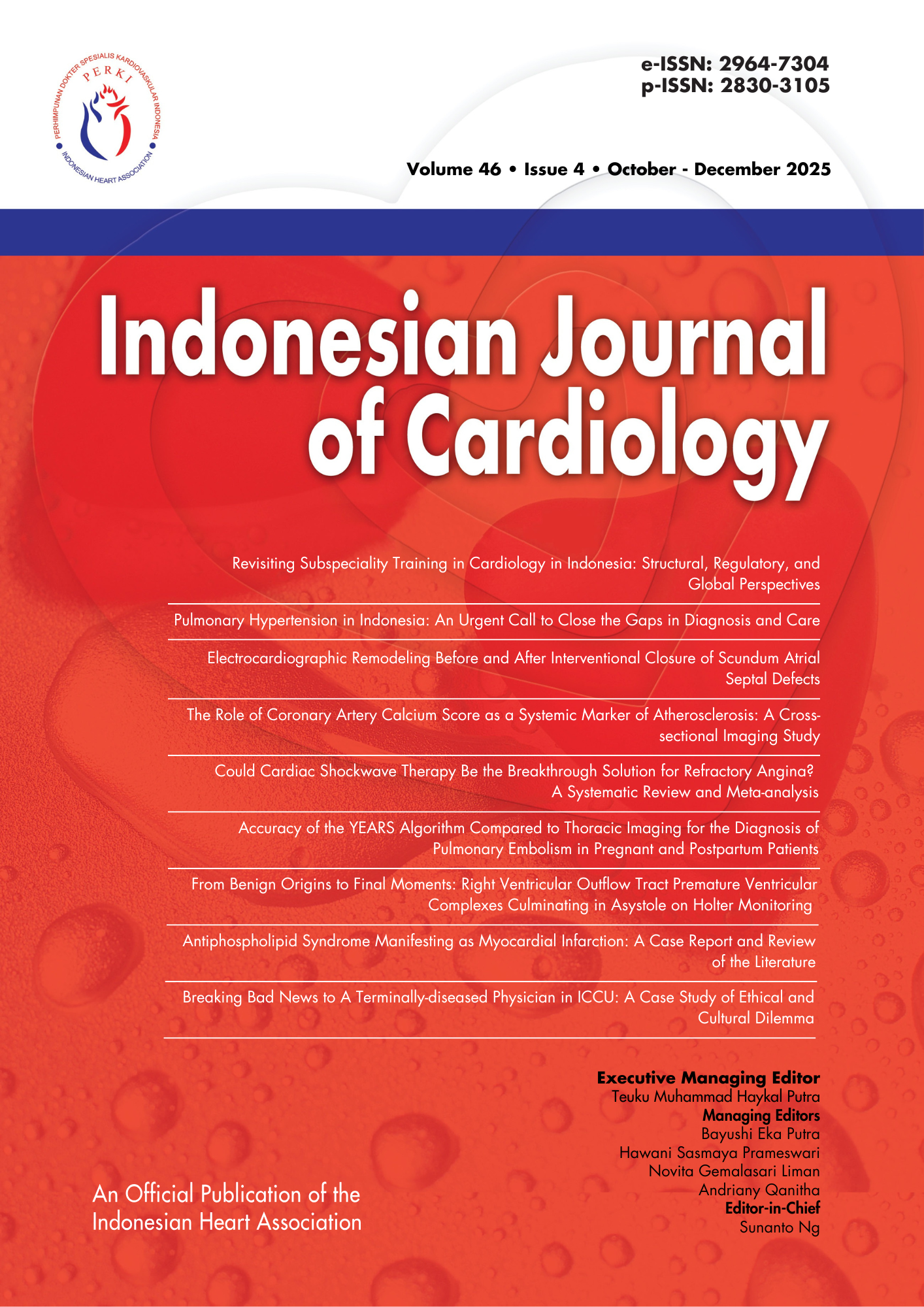
From Benign Origins to Final Moments: Right Ventricular Outflow Tract Premature Ventricular Complexes Culminating in Asystole on Holter Monitoring
Abstract
Background: Premature Ventricular Complexes (PVCs) are a common cardiac arrhythmia typically of benign nature. Their origin, the right ventricular outflow tract (RVOT), is often a point of interest due to its implications in treatment strategies. While the vast majority of PVC RVOT cases remain uneventful, there are isolated incidents that challenge this common perception. Continuous monitoring methods, such as the Holter monitor, have provided invaluable insights into the real-world dynamics of arrhythmias, capturing rare events that can be of paramount clinical significance.
Case Illustration: A 60-year-old female, presented to Harapan Kita Hospital Jakarta in May with palpitations. Over several visits, physical examinations consistently indicated a heart within normal parameters, absent of murmurs or gallop. Successive ECGs revealed persistent PVCs of RVOT origin. Despite medical intervention, her arrhythmic pattern persisted. By September, her symptoms had diversified, including occasional chest pain, nausea, and dyspnea. An ECG, yet again, confirmed PVCs with RVOT origin. During a Holter monitoring session on September, a distressing sequence of events was captured. The monitor initially registered a non-sustained Ventricular Tachycardia (VT). which escalated to sustained VT, ventricular fibrillation, and culminating in asystole, marking the patient's final moments.
Conclusions: The pathophysiological journey from benign PVCs of RVOT origin to a fatal arrhythmic event underscores the unpredictability and inherent dangers of cardiac arrhythmias. This case is a reminder of the critical importance of persistent monitoring, timely interventions, and the nuanced understanding of conditions conventionally deemed 'benign'.
Downloads
References
2. Koester C, Ibrahim AM, Cancel M, Labedi MR. The Ubiquitous Premature Ventricular Complex. Cureus. 2020;12(1):1-10.
3. Lin CY, Chang SL, Lin YJ, Lo LW, Hu YF, Tuan TC, et al. Long-term outcome of multiform premature ventricular complexes in structurally normal heart. Int J Cardiol. 2019;293:7-12.
4. Srinivasan NT, Schilling RJ, Ahsan SY. Ablation of premature ventricular complexes: should we, can we, and why? Eur Heart J. 2018;39(37):3274-6.
5. Marcus GM. Evaluation and Management of Premature Ventricular Complexes. Circulation. 2020;141(17):1404-18.
6. Hsia HH, Lin D. Diagnosis and management of premature ventricular complexes. Trends Cardiovasc Med. 2017;27(6):422-8.
7. Johnson ER, Patel RK. Management Strategies for Patients with Frequent Premature Ventricular Complexes. J Cardiol Cardiovasc Med. 2022;9:100034.
8. Pirimoglu B, Duran A, Duran C. Right ventricular outflow tract tachycardia: A common rhythm due to an uncommon etiology. Eurasian J Med. 2019;51(2):202-4.
9. Ward RC, van Zyl M, DeSimone CV. Idiopathic Ventricular Tachycardia. J Clin Med. 2023;12(3).
10. Latchamsetty R, Bogun F. Frequent premature ventricular complexes are benign!? Europace. 2023;25(2):251-2.
11. Aras K, Gams A, Faye NR, Brennan J, Goldrick K, Li J, et al. Electrophysiology and Arrhythmogenesis in the Human Right Ventricular Outflow Tract. Circ Arrhythm Electrophysiol. 2022;15(3):e010630.
12. Mariani MV, Piro A, Della Rocca DG, Forleo GB, Pothineni NV, Romero J, et al. Electrocardiographic criteria for differentiating left from right idiopathic outflow tract ventricular arrhythmias. Arrhythm Electrophysiol Rev. 2021;10(1):10-16.
13. Panizo JG, Barra S, Mellor G, Heck P, Agarwal S. Premature ventricular complex-induced cardiomyopathy. Arrhythm Electrophysiol Rev. 2018;7(2):128.
14. Lu YY, Chen YC, Lin YK, Chen SA, Chen YJ. Electrical and Structural Insights into Right Ventricular Outflow Tract Arrhythmogenesis. Int J Mol Sci. 2023;24(14).
15. Penela D, Teres C, Fernández-Armenta J, Aguinaga L, Tercedor L, Soto-Iglesias D, et al. Premature ventricular complex site of origin and ablation outcomes in patients with prior myocardial infarction. Heart Rhythm. 2021;18(1):27-33.
16. Keleş N. Does premature ventricular complex impair left ventricular diastolic functions? Anatol J Cardiol. 2023.
17. Scorza R, Jonsson M, Friberg L, Rosenqvist M, Frykman V. Prognostic implication of premature ventricular contractions in patients without structural heart disease. Europace. 2023;25(2):517-25.
PDF downloads: 570
Copyright (c) 2025 Indonesian Journal of Cardiology

This work is licensed under a Creative Commons Attribution 4.0 International License.
Authors who publish with this journal agree to the following terms:
- Authors retain copyright and grant the journal right of first publication with the work simultaneously licensed under a Creative Commons Attribution License that allows others to share the work with an acknowledgement of the work's authorship and initial publication in this journal.
- Authors are able to enter into separate, additional contractual arrangements for the non-exclusive distribution of the journal's published version of the work (e.g., post it to an institutional repository or publish it in a book), with an acknowledgement of its initial publication in this journal.
- Authors are permitted and encouraged to post their work online (e.g., in institutional repositories or on their website) prior to and during the submission process, as it can lead to productive exchanges, as well as earlier and greater citation of published work (See The Effect of Open Access).