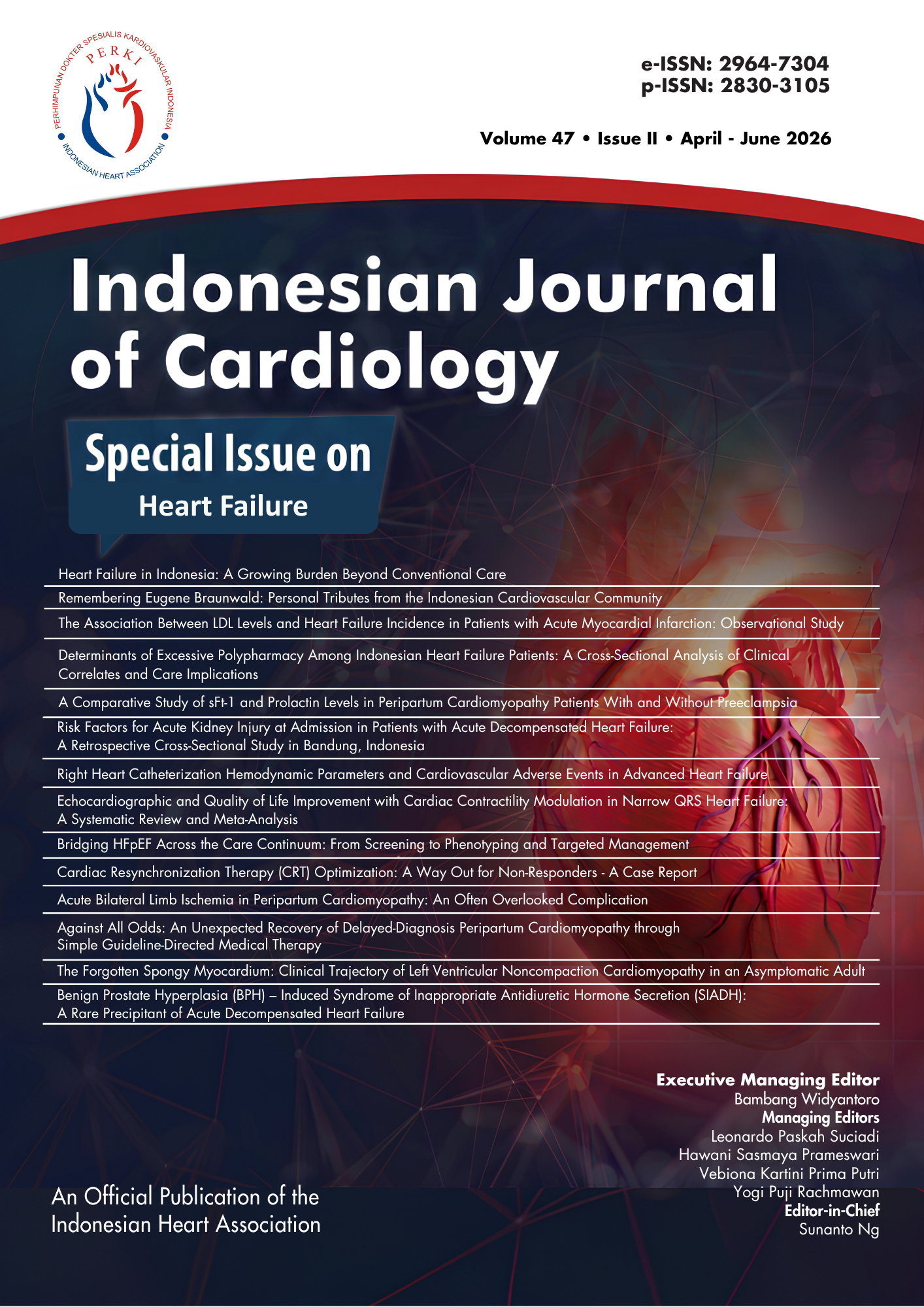
Acute Bilateral Limb Ischemia in Peripartum Cardiomyopathy: An Often Overlooked Complication
Abstract
Background:
Peripartum Cardiomyopathy is a specific subset of systolic heart failure with potentially devastating complications. Thromboembolism, as one of the complications, requires a careful evaluation to assess risk and guide management. This case report of acute limb ischemia complicating peripartum cardiomyopathy is an example of how to deal with thromboembolism in PPCM.
Case Illustration:
A 42-year-old woman came to our center with a classic presentation of acute heart failure; dyspnea on effort, paroxysmal nocturnal dyspnea, and orthopnea. These complaints started 4 months ago, just three weeks after her second childbirth. She had not taken medications diligently. Rales were heard on both lungs, with elevated jugular pressure and pitting edema on the extremities. Echocardiography revealed a dilated heart and reduced LVEF of 23%. She was diagnosed with PPCM and treated accordingly. On the first night in hospital, she felt sudden pain and paresthesia in her right foot. Distal pulse was weakly palpated, and there was hypoesthesia in the toes. Duplex ultrasound found fresh thrombi in bilateral popliteal arteries. Diagnosis of acute limb ischemia was confirmed, warranting the use of anticoagulants aside from her existing heart failure medications. Symptoms continued to improve until discharge.
Conclusion:
A case of a 42-year-old pregnant woman diagnosed with PPCM suffering from an acute thromboembolic episode was reported. Risk assessment is essential to predict the occurrence of future thromboembolism and therefore take necessary prevention before they happen. Different anticoagulants are indicated for different PPCM patient profiles, and careful consideration regarding their safety profile for this particular population is needed.
Downloads
References
2. MB Davis, Arany Z, McNamara DM, Goland S, Elkayam U. Peripartum Cardiomyopathy: JACC State-of-the-Art Review. J Am Coll Cardiol. 2020;75(2):207–21.
3. Bauersachs J, Konig T, van der Meer P, Petrie MC, Hilfiker-Kleiner D, Mbakwem A, et al. Pathophysiology, diagnosis and management of peripartum cardiomyopathy: a position statement from the Heart Failure Association of the European Society of Cardiology Study Group on peripartum cardiomyopathy. Eur J Heart Fail. 2019; 21(7): 821-43.
4. Touhami O, Marzouk SB, Bennasr L, Touaibia M, Souli I, Felfel MA, et al. Are the Wells Score and the Revised Geneva Score valuable for the diagnosis of pulmonary embolism in pregnancy? Eur J Obstet Gynecol Reprod Biol. 2018;221:166–71.
5. Nelson-Piercy C. Reducing the Risk of Venous Thromboembolism during Pregnancy and the Puerperium. Green Top Guideline no. 37a. Royal College of Obstetricians and Gynecologists. 2015.
6. Lindqvist PG, Bremme K, Hellgren M, Working Group on Hemostatic Disorders (Hem-ARG), Swedish Society of Obstetrics and Gynecology. Efficacy of obstetric thromboprophylaxis and long-term risk of recurrence of venous thromboembolism. Acta Obstet Gynecol Scand. 2011;90(6):648–53.
7. Bates SM, Middeldorp S, Rodger M, James AH, Greer I. Guidance for the treatment and prevention of obstetric-associated venous thromboembolism. J Thromb Thrombolysis. 2016;41(1):92–128.
8. Hoes MF, Arany Z, Bauersachs J, Hilfiker-Kleiner D, Petrie MC, Sliwa K, et al. Pathophysiology and risk factors of peripartum cardiomyopathy. Nat Rev Cardiol. 2022;19(8):555–65.
9. Arrigo M, Blet A, Mebazaa A. Bromocriptine for the treatment of peripartum cardiomyopathy: welcome on BOARD. Eur Heart J. 2017;38(35):2680–2.
10. Hilfiker-Kleiner D, Haghikia A, Berliner D, Vogel-Claussen J, Schwab J, Franke A, et al. Bromocriptine for the treatment of peripartum cardiomyopathy: a multicentre randomized study. Eur Heart J. 2017;38(35):2671–9.
11. Iffy L, Lindenthal J, Mcardle JJ, Ganesh V. Severe cerebral accidents postpartum in patients taking bromocriptine for milk suppression. Isr J Med Sci. 1996;32(5):309–12.
12. Loewe C, Dragovic LJ. Acute coronary artery thrombosis in a postpartum woman receiving bromocriptine. Am J Forensic Med Pathol. 1998;19(3):258–60.
13. Maybury HJ, Waugh JJS, Gornall A, Pavord S. There is a return to non-pregnant coagulation parameters after four not six weeks postpartum following spontaneous vaginal delivery. Obstet Med. 2008;1(2):92–4.
14. Kamel H, Navi BB, Sriram N, Hovsepian DA, Devereux RB, Elkind MSV. Risk of a thrombotic event after the 6-week postpartum period. N Engl J Med. 2014;370(14):1307–15.
15. Kane A, Mbaye M, Ndiaye MB, Diao M, Moreira PM, Mboup C, et al. [Evolution and thromboembolic complications of the idiopathic peripartal cardiomyopathy at Dakar University Hospital: forward-looking study about 33 cases]. J Gynecol Obstet Biol Reprod . 2010;39(6):484–9.
16. Ibebuogu UN, Thornton JW, Reed GL. An unusual case of peripartum cardiomyopathy manifesting with multiple thrombo-embolic phenomena. Thromb J. 2007;5(1):18.
17. Toutai C, Kallel O, Houssam L, Ismaili N, Elouafi N. When a Peripartum Cardiomyopathy Patient Hides Various and Serious Risk Factors for Recurrent and Fatal Thromboembolic Events Even Under Well-Conducted Oral Anticoagulation. Cureus. 2020;12(12):e12392.
18. Mahmoudi E, Tabary M, Khaheshi I. Pulmonary thromboembolism presenting with chest pain in a case of peripartum cardiomyopathy. Future Cardiol. 2020;16(4):263–9.
19. Nasa P, Mortada M, Ali A, Malhotra V, Koul K, Singh A. Cardioembolic Stroke with Peripartum Cardiomyopathy: An Unusual Presentation. Indian J Crit Care Med. 2021;25(1):97–9.
20. Carlson KM, Browning JE, Eggleston MK, Gherman RB. Peripartum cardiomyopathy presenting as lower extremity arterial thromboembolism. A case report. J Reprod Med. 2000;45(4):351–3.
21. Aboyans V, Ricco JB, Bartelink MLEL, Björck M, Brodmann M, Cohnert T, et al. 2017 ESC Guidelines on the Diagnosis and Treatment of Peripheral Arterial Diseases, in collaboration with the European Society for Vascular Surgery (ESVS): Document covering atherosclerotic disease of extracranial carotid and vertebral, mesenteric, renal, upper and lower extremity arteriesEndorsed by: the European Stroke Organization (ESO)The Task Force for the Diagnosis and Treatment of Peripheral Arterial Diseases of the European Society of Cardiology (ESC) and of the European Society for Vascular Surgery (ESVS). Eur Heart J. 2018;39(9):763–816.
22. Norgren L, Hiatt WR, Dormandy JA, Nehler MR, Harris KA, Fowkes FGR, et al. Inter-Society Consensus for the Management of Peripheral Arterial Disease (TASC II). J Vasc Surg. 2007;45 Suppl S:S5–67.
23. Zhu X, Wang Z, Ferrari MW, Ferrari-Kuehne K, Bulter J, Xu X, et al. Anticoagulation in cardiomyopathy: unravelling the hidden threat and challenging the threat individually. ESC Heart Fail. 2021;8(6):4737–50.
24. Abou-Ismail MY, Citla Sridhar D, Nayak L. Estrogen and thrombosis: A bench to bedside review. Thromb Res. 2020;192:40–51.
25. Sliwa K, Petrie MC, Hilfiker-Kleiner D, Mebazaa A, Jackson A, Johnson MR, et al. Long‐term prognosis, subsequent pregnancy, contraception and overall management of peripartum cardiomyopathy: practical guidance paper from the Heart Failure Association of the European Society of Cardiology Study Group on Peripartum Cardiomyopathy. Eur J Heart Fail. 2018;20(6):951–62.
26. Tepper NK, Dragoman MV, Gaffield ME, Curtis KM. Nonoral combined hormonal contraceptives and thromboembolism: a systematic review. Contraception. 2017;95(2):130–9.
27. Rosman L, Salmoirago-Blotcher E, Wuensch KL, Cahill J, Sears SF. Contraception and reproductive counseling in women with peripartum cardiomyopathy. Contraception. 2017;96(1):36–40.
PDF downloads: 427
Copyright (c) 2026 Indonesian Journal of Cardiology

This work is licensed under a Creative Commons Attribution 4.0 International License.
Authors who publish with this journal agree to the following terms:
- Authors retain copyright and grant the journal right of first publication with the work simultaneously licensed under a Creative Commons Attribution License that allows others to share the work with an acknowledgement of the work's authorship and initial publication in this journal.
- Authors are able to enter into separate, additional contractual arrangements for the non-exclusive distribution of the journal's published version of the work (e.g., post it to an institutional repository or publish it in a book), with an acknowledgement of its initial publication in this journal.
- Authors are permitted and encouraged to post their work online (e.g., in institutional repositories or on their website) prior to and during the submission process, as it can lead to productive exchanges, as well as earlier and greater citation of published work (See The Effect of Open Access).