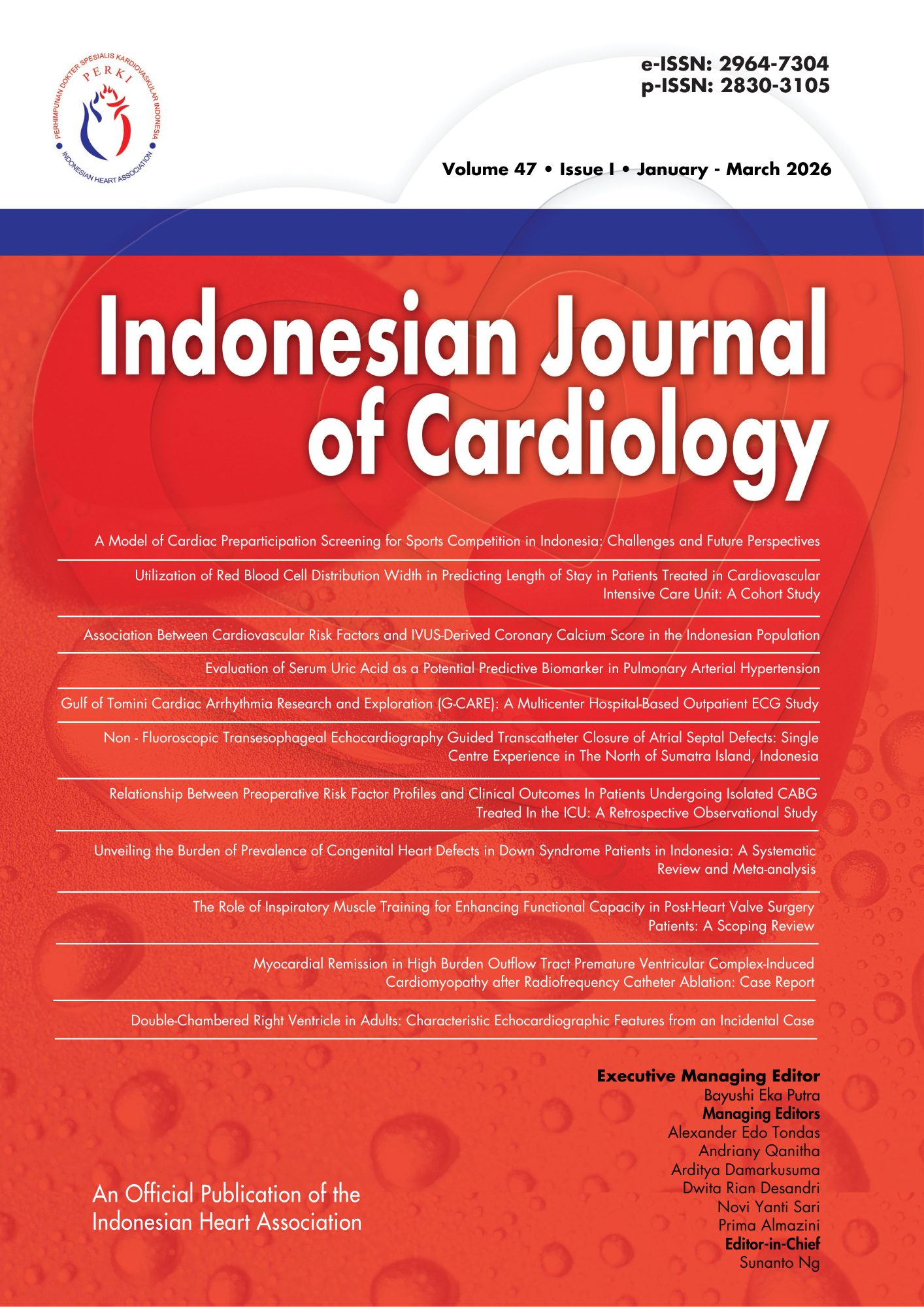
The Role of Inspiratory Muscle Training for Enhancing Functional Capacity in Post Heart Valve Surgery Patients: A Scoping Review
Abstract
Background: Valvular Heart Disease (VHD), particularly Rheumatic Heart Disease (RHD), is a major health burden in Indonesia, often requiring heart valve surgery. Post-operative respiratory muscle dysfunction and reduced functional capacity hinder recovery. Inspiratory Muscle Training (IMT) is a non-invasive intervention that improves respiratory muscle strength and functional outcomes. This scoping review evaluates the role of IMT in enhancing functional capacity among patients after heart valve surgery.
Methods: A systematic search of PubMed and Scopus identified Randomized Controlled Trials (RCTs) and cohort studies involving adult patients who underwent IMT interventions after heart valve surgery. The search strategy combined controlled vocabulary (Medical Subject Headings [MeSH]) Key terms included: (“heart valve surgery” OR “valve replacement” OR “valvular heart disease”) AND (“inspiratory muscle training” OR “respiratory muscle training”) AND (“functional capacity” OR “exercise capacity” OR “respiratory muscle strength” OR “pulmonary function”). Outcomes included functional capacity, respiratory muscle strength, pulmonary function, Post-operative Pulmonary Complications (PPCs), and hospital Length of Stay (LOS). Data were synthesized narratively.
Results: Four RCTs (273 patients) showed IMT significantly improved Maximal Inspiratory Pressure (MIP), Six-Minute Walk Distance (6MWD), and pulmonary function [Forced Vital Capacity (FVC), Forced Expiratory Volume in 1 second (FEV₁)]. Interventions of 4–12 weeks reduced PPCs and LOS. Optimal benefits were observed with 8–12-week protocols.
Conclusion: IMT enhances functional capacity, respiratory muscle strength, and pulmonary function post-heart valve surgery, with the potential to reduce complications and costs. Its integration into rehabilitation programs is recommended, particularly in regions with high RHD prevalence, such as Indonesia. Further studies should standardize protocols and assess long-term outcomes.
Downloads
References
2. GBD 2017 Disease and Injury Incidence and Prevalence Collaborators. Global, regional, and national incidence, prevalence, and years lived with disability for 354 diseases and injuries for 195 countries and territories, 1990–2017: a systematic analysis for the Global Burden of Disease Study 2017. Lancet. 2018;392(10159):1789–858.
3. Otto CM, Nishimura RA, Bonow RO, et al. 2020 ACC/AHA guideline for the management of patients with valvular heart disease. J Am Coll Cardiol. 2021;77(4):e25–e197.
4. Sobrinho MT, Guirado GN, Silva MA. Inspiratory muscle training in patients after cardiac surgery: systematic review. Rev Bras Cir Cardiovasc. 2015;30(4):498–504.
5. Katsura M, Kuriyama A, Takeshima T, et al. Preoperative inspiratory muscle training for post-operative pulmonary complications in adults undergoing cardiac surgery. Cochrane Database Syst Rev. 2015;2015(9):CD010356.
6. Medrinal C, Combret Y, Prieur G, et al. Respiratory weakness after mechanical ventilation is associated with diaphragm dysfunction. Crit Care. 2016;20:231.
7. Da Silva FMF, Cipriano G Jr, Lima AC, et al. Maximal dynamic inspiratory pressure evaluation in heart failure: a comprehensive analysis. Phys Ther. 2020;100(12):2246–53.
8. Kendall F, Oliveira J, Peixoto-Souza FS, et al. Inspiratory muscle training reduces post-operative pulmonary complications in patients undergoing coronary artery bypass graft surgery. Disabil Rehabil. 2018;40(8):864–82.
9. Vorona S, Sabatini U, Al-Maqbali J, et al. Inspiratory muscle training improves weaning outcomes in patients with prolonged mechanical ventilation: a randomized trial. J Crit Care. 2022;67:66–73.
10. Shei RJ, Paris HLR, Wilhite DP, et al. Time to move beyond a “one-size fits all” approach to inspiratory muscle training. Front Physiol. 2022;12:766346.
11. Tricco AC, Lillie E, Zarin W, et al. PRISMA extension for scoping reviews (PRISMA-ScR): checklist and explanation. Ann Intern Med. 2018;169(7):467–73.
12. Cargnin C, Karsten M, Guaragna JC, et al. Inspiratory muscle training after heart valve replacement surgery improves inspiratory muscle strength and functional capacity. J Cardiopulm Rehabil Prev. 2019;39(6):E1–E7.
13. Kodric M, Trevisan R, Torregiani C, Cifaldi R, Longo C, Cantarutti F, Confalonieri M. Inspiratory muscle training for diaphragm dysfunction after cardiac surgery. J Thorac Cardiovasc Surg. 2013 Mar;145(3):819-23.
14. Xu L, Wang X, Chen Y, et al. Inspiratory muscle training improves cardiopulmonary function in patients post-transcatheter aortic valve replacement: a randomized controlled trial. Eur J Prev Cardiol. 2023;30(3):191–202.
15. Hegazy FA, Kamel IIM, Abdelrahman AA, et al. Effect of inspiratory muscle training on functional capacity and respiratory muscle strength in patients post-mitral valve replacement. J Bodyw Mov Ther. 2021;27:568–74.
16. Ramsook AH, Koo R, Molgat-Seon Y, et al. Diaphragm recruitment increases during inspiratory muscle training in healthy individuals. Med Sci Sports Exerc. 2016;48(6):1179–86.
17. Bissett B, Leditschke IA, Green M, et al. Respiratory muscle rehabilitation in patients with prolonged mechanical ventilation: a randomized controlled trial. Crit Care. 2020;24(1):103.
18. Zhang S, Wu J, Chen X, et al. Effects of inspiratory muscle training on patients undergoing coronary artery bypass grafting: a systematic review. Rev Cardiovasc Med. 2023;24(1):16.
19. Garofano M, Poli A, Boffa GM, et al. Technological developments in cardiac telerehabilitation: a systematic review. Healthcare. 2024;12(15):1534.
20. Baumgartner H, Falk V, Bax JJ, et al. 2017 ESC/EACTS guidelines for the management of valvular heart disease. Eur Heart J. 2017;38(36):2739–91.
21. Cowie MR, Lam CSP. Heart failure and valvular heart disease: challenges and opportunities. Eur Heart J Suppl. 2021;23(Suppl E):E147–E153.
22. Hill JC, Timmis A, Pinto FJ. Managing patients with valvular heart disease in the 21st century. Eur Heart J. 2020;41(34):3207–9.
23. Raddatz MA, Gonzales AJ, Friedrich AW, et al. Inspiratory muscle training in chronic heart failure: a systematic review and meta-analysis. Heart Lung. 2022;55:1–10.
24. Gomes-Neto M, Rodrigues ES Jr, Silva WM Jr, et al. Effects of inspiratory muscle training on respiratory muscle strength, lung function, and functional capacity in patients with heart failure: a systematic review and meta-analysis. Heart Lung. 2020;49(5):540–6.
25. Dos Santos TD, Pereira SN, Portela LOC, et al. Effects of inspiratory muscle training on functional capacity and quality of life in patients with heart failure: a meta-analysis. J Cardiopulm Rehabil Prev. 2023;43(2):79–86.
PDF downloads: 631
Copyright (c) 2026 Indonesian Journal of Cardiology

This work is licensed under a Creative Commons Attribution 4.0 International License.
Authors who publish with this journal agree to the following terms:
- Authors retain copyright and grant the journal right of first publication with the work simultaneously licensed under a Creative Commons Attribution License that allows others to share the work with an acknowledgement of the work's authorship and initial publication in this journal.
- Authors are able to enter into separate, additional contractual arrangements for the non-exclusive distribution of the journal's published version of the work (e.g., post it to an institutional repository or publish it in a book), with an acknowledgement of its initial publication in this journal.
- Authors are permitted and encouraged to post their work online (e.g., in institutional repositories or on their website) prior to and during the submission process, as it can lead to productive exchanges, as well as earlier and greater citation of published work (See The Effect of Open Access).